
Januário Agostinho de Almeida (1887–1954) – An Educator
By Patrick A de Lemos Rozario
I had long intended to write an article about my great‑granduncle, Januário Agostinho de Almeida, the brother of my maternal great‑grandmother, D. Ângela Regina de Almeida de Lemos. This intention took shape after I read The Macanese Diaspora in British Hong Kong by Catherine S. Chan in 2022, which discusses Januário’s advocacy of Portuguese culture in Hong Kong during the 1930s - an aspect of his life that had remained largely unknown to more recent generations of our family.
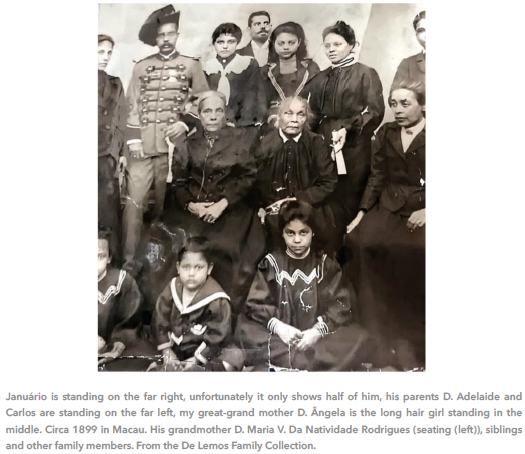
Januário Agostinho de Almeida was born in Macau on 22 February 1887 into a long‑established Macanese family with deep roots in Portuguese Asia. Januário’s father is Carlos Eugénio de Almeida and the mother is D. Adelaide Maria Marques who was born in Hong Kong in 1856.
The name Januário Agostinho de Almeida recurs across generations, including that of his grandfather. The earliest known bearer was Januário Agostinho de Almeida, Barão de São José de Porto Alegre (1759–1825), Januário’s great‑great‑grandfather. Born in Lisbon (Ajuda), the Barão (Baron in Portuguese)arrived in Macau in the late 1770s, where he became a prominent merchant and later served as the founder and first president of the Casa de Seguros de Macau. He died in Calcutta in 1825, and his legacy endures in Macau through street names including Calçada da Januário and Rua do Barão.
Roots in Macau
At the end of the nineteenth century, Macau remained culturally Portuguese but economically fragile. Many Macanese families, including Januário’s generation, invested heavily in education-especially multilingual literacy in Portuguese, French and English-as a means of mobility. These skills allowed Macanese men to find work in colonial administrations, shipping firms, utilities, and postal services across the Pearl River Delta, particularly in Hong Kong.
Given the educational patterns of the period and his later interest in education, it is plausible that Januário received at least part of his education at Seminário de São José. However, no surviving records have been found to confirm his attendance.
Januário’s grew up in an environment of cultural hybridity, shaped by Portuguese Catholic traditions, Chinese social realities, and a growing British imperial presence nearby. This background later shaped his deep concern for Portuguese identity and the preservation of the language among Macanese youth.
Moving to Hong Kong
Like many of his contemporaries, Januário moved to Hong Kong as a young adult, joining the expanding colonial workforce. He secured employment as a clerk with the Hongkong Post Office, a position that reflected both his education and the trust placed in Macanese staff within the British civil service.
Postal and telecommunication services were critical institutions in pre–World War II Hong Kong, linking the colony to global imperial networks. Macanese clerks often occupied indispensable middle-ranking roles, combining linguistic competence with administrative reliability. Januário’s career followed this established professional path, situating him firmly within Hong Kong’s colonial infrastructure.
Cultural and Educational Commitment
Beyond his work in the Post Office, together with his wife, Corina Sara Antunes de Almeida,Januário taught Portuguese for Escola de Portugues, St. Joseph’s College and La Salle College, particularly to younger members of the Macanese community in Hong Kong. I spoke with Fredric (Jim) Silva and D. Amália Maria de Oliveira Sales whose maternal greatgrandmother D. Emilia Carolina de Almeida Azedo was the sister of Januário’s father. They both recalled that Januário had been their Portuguese language teacher. Language, for Januário, was not merely a practical skill but a vessel of history and identity.

This conviction culminated in 1929, when he founded the Liga Portuguesa de Hongkong on 2 July 1929 at 15 Hankow Road. The Liga began modestly, operating from small premises that included a library and a bar, initially served its limited membership. Januário actively fostered collaboration with the Associação Portuguesa de Socorros Mútuos and Club de Recreio. He later became Honorary Secretary of the Associação and secured an arrangement that allowed the Liga to use the Club de Recreio’s premises for larger‑scale activities.
Liga Portuguesa cultivated a strong and expressive sense of community, ran its own football, softball, and rifle teams as extensions of collective identity and discipline. It also adopted a distinctive emblem and hymn; the latter performed at formal gatherings prior to the Portuguese national anthem.

The hymn articulated an ethos of enduring patriotism anddevotion to Portugal. It opened with an appeal to unity - “Irmãos de raça, andai unidos” (“Brothers of one lineage,walk together”) - and rose
toward a hopeful affirmation ofprogress and shared destiny:
Avante, pois, (Onward, then)
Avante, irmãos, (Onward, brothers)
Pelo nosso grande ideal, (For our great ideal)
Pelo glorioso porvir (For the glorious future)
Da nossa amada Portugal! (Of our beloved Portugal!)
The Liga was explicitly nationalistic and cultural, aiming to reinvigorate Portuguese consciousness among Macanese youth and to promote the systematic teaching and use of the Portuguese language in an overwhelmingly Anglophone colonial environment. At a time when assimilation pressures were strong, the Liga represented a conscious effort to resist cultural erosion. Januário’s initiative reflected broader anxieties within the Macanese diaspora, many of whom feared the gradual dilution of Portuguese heritage in Hong Kong’s cosmopolitan society.
By 1935, associations like the Liga Portuguesa had begun to emerge across several Asian port cities, reflecting the consolidation of a transnational Macanese and Portuguese‑affiliated diaspora. Among these was the Liga Cívica Portuguesa of Shanghai, which aimed to foster civility, social cohesion, and a shared sense of cultural belonging among Macanese communities in Hong Kong and Shanghai. In Kobe, the formation of the Associação Portuguesa de Kobe further illustrates the extension of these diasporic networks within East Asia.
By this period, the Liga Portuguesa’s newspaper, A Comunidade, had established a correspondent network spanning Macau, Shanghai, Canton, and Kobe, thereby facilitating the circulation of ideas, news, and identity narratives across geographically dispersed communities. Through its editorial stance, A Comunidade articulated a form of diasporic Portuguese nationalism that sought to reaffirm cultural ties to Portugal while simultaneously negotiating the distinct historical and social position of Macanese communities within colonial and semi‑colonial Asian contexts. The photo dated 1932, was likely taken in Hong Kong.
The Late 1930s and Regional Uncertainty

The late 1930s brought mounting instability to East Asia. In 1937, amid the escalation of the Sino Japanese War, Januário left Hong Kong for Japan. While the precise nature of his activities there is not documented, his departure coincided with growing regional insecurity and shifting geopolitical alignments that disrupted longestablished Macanese migration patterns. Januário returned permanently to Macau before the Japanese occupation of Hong Kong (1941–1945), a period that proved devastating for many Portuguese and Macanese families, who were displaced, interned, or forced to flee to neutral Macau. According to family accounts, he taught at Instituto Salesiano (the Salesian School) after returning to Macau and is also believed to have assisted refugees during the war years. The photo below taken in late 1930’s with the bishop and likely his colleagues at the Salesian school in Macau.

Another family story has always stayed with me. Januário was the godfather of my father, Pedro José Rozario. At his baptism in Macau, and after the Japanese occupation of Hong Kong, my father returned to Macau as a young teenager. During those uncertain years, he studied at São Rafael Hospital, helping out with chores while receiving his education from the Italian nuns. He remained forever grateful to the nuns throughout his life, for it was under their guidance that his love of learning took root and that he became proficient in both Portuguese and English. Our family has long believed that Januário played a pivotal role in making this possible, quietly ensuring that my father could continue his education during the war years.
Final Years
Januário lived out his final years quietly, witnessing the post-war transformation of the region and the gradual reorientation of Macanese life away from colonial certainties. He died in 1954 at the São Rafael Hospital in Macau, aged 67, closing a life that had bridged two colonial cities and embodied the civicminded professionalism of his generation.
Legacy
Januário Agostinho de Almeida is remembered for cultural stewardship. His work as a civil servant, educator, and founder of the Liga Portuguesa de Hongkong reflects the broader contributions of Macanese professionals who sustained institutions, languages, and identities across imperial boundaries. His life stands as a representative case of the Macanese diaspora in British Hong Kong, navigatingmodernity while striving to preserve a distinct Portuguese-Macanese heritage.