
From Clerks to CEOs: The Enduring and Complex Legacy of the Portuguese at HSBC
By Ken Chad
Introduction: More Than Bricks and Mortar
When the Hongkong and Shanghai Banking Corporation opened its new headquarters at 1 Queen’s Road Central on 10 October 1935, it was a statement of overwhelming confidence. Described as Hong Kong’s first skyscraper, the fourteen-storey, airconditioned behemoth dominated the colonial skyline, its entrance guarded by two famously snarling bronze lions. [15] For a century, the banks had been the powerhouse of the colony, and HSBC was by far the largest. Yet, the true strength of the institution lay
not just in its granite and steel, but in the hundreds of employees who reflected the complex social and
economic strata of Hong Kong itself. [1]
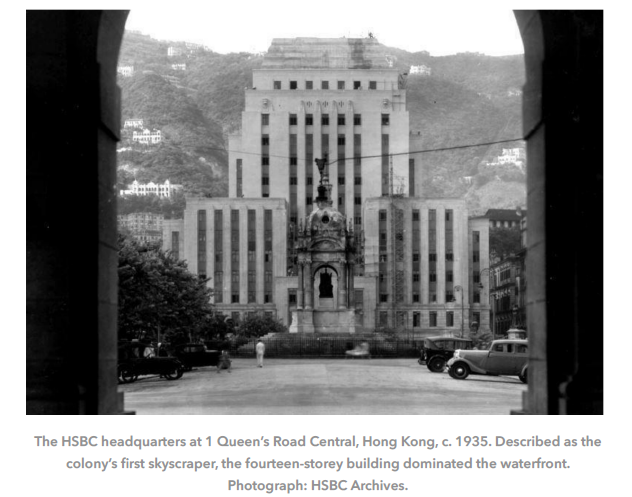
Among the most vital of these were the members of the Portuguese community. From the Bank’s very inception in 1865, Portuguese clerks were the skilled, diligent, and indispensable backbone of its daily operations. Their story, however, is a complex tapestry woven with threads of profound loyalty and exceptional competence but also stained by the persistent injustice of a colonial glass ceiling of that time. It is a narrative that stretches from the earliest days of quill pens and handwritten ledgers to the modern era of global finance, where Portuguese names have now come to adorn the highest echelons of HSBC’s global leadership. This article, drawing on archival material, historical records, and personal testimonies, seeks to tell that story; one of an enduring contribution that has often remained in the shadows of official history.
The Foundation Years (1865–1900): The Three-Tier Staff Structure
From its first day of business, HSBC, like many other foreign firms on the China coast, adopted a rigid, unwritten but universally understood three-tiered staffing structure. As historian Frank H.H. King documents, this system would be formalised by the 1880s and prevail for nearly a century, until the 1950s. [2]
The Three Tiers of Staff
1. The ‘Eastern Staff’: A London-recruited, an almost exclusively British cadre of managers destined for executive roles, who could be transferred at will across the Bank’s growing empire. As Chief Manager Sir Vandeleur Grayburn himself remarked: “There is only one American in the Bank and that is one too many.” [3]
2. The Intermediate Clerical Staff: A loyal, long-serving group recruited locally to remain in their home office. In Hong Kong and Shanghai, this tier was composed almost entirely of the ‘Hong Kong
Portuguese’ (this is how they were termed in early census returns, to distinguish them from metropolitan European Portuguese), while in Ceylon (Sri Lanka), their counterparts were the Eurasian ‘Burghers’. In far-away Aden and East Africa the Goans fulfilled this role. In all cases these Luso-Asians were practically the only non European inhabitants with a command of the Latin script and a growing capacity of the English language. [12]
3. The Compradore’s Staff: The Chinese staff responsible for handling local currency, navigating local
markets, and at that time performing menial tasks, all under the guarantee of a powerful Chinese compradore. The word compradore itself is of Portuguese origin meaning a ‘purchaser’. It initially referred to a local servant in a Portuguese household in Macau or Guangdong who would negotiate the sale or barter of his master’s goods with local traders.
The Chinese staff of the third tier were themselves possessed of remarkable skills. The cashiers, in particular, were renowned for the dextrous competence with which they handled their abacuses, counting and calculating with a rapidity, accuracy, and skill that astonished onlookers. Their contribution to the Bank’s daily operations, though seldom recorded, was no less essential.
This structure placed the Portuguese in a liminal space: respected for their skill and loyalty yet barred from the executive path. The diary of Constancio Joaquim Gonsalves, a clerk who joined the Bank at its founding in 1865, provides a rare and intimate glimpse into this world. His entries from 1871 reveal the immense workload, the pride in his craft, and the financial precarity of his position.
“I was trying to balance my Register, but could not succeed – share brokers and other shareholders did not give me time to attend to my work. They were bothering me for information relating to shares etc… I am still unable to balance my books.” [4]
This pressure was compounded by a stark pay disparity. Gonsalves’ salary was between $80 and $100 a month, while a newly arrived European junior, Gifford Moody, started at $100 with the significant perk of free quarters in the Bank building, a benefit not extended to the Portuguese staff. [4] Gonsalves’ diary poignantly records his struggles, noting his overdraft of $131.62 and the Manager’s initial refusal to honour a cheque for his $32 rent. [4] When a colleague in Shanghai, Carvalho, wrote under the mistaken impression that Hong Kong clerks were paid better, Gonsalves’ frustration is palpable: “How wrong the Shanghai people are!!!” [4]
Despite these limitations, the Portuguese were not merely employees; they were investors. As King notes, HSBC shares were seen as “sound investments by clerical wage-earners,” and several Portuguese names appear on the early shareholder registers, demonstrating a deep-seated belief in the institution they so faithfully served. [5] The Bank, in turn, showed a paternalistic, if inconsistent, sense of duty. In 1890, when E.J. Pereira, a “pioneer Portuguese officer sent in 1866 from Hong Kong to Yokohama,” suffered a paralytic stroke, the Bank paid his hospital fees, passage home, and a half-pay pension, minuting its intent to support his widow should he pass away. [6]
The Imperial Heyday (1900–1941): An Institutionalised Divide
As the Bank entered the twentieth century, the three-tier system became further entrenched. The most powerful visual evidence of this segregation comes from the opening of the new Head Office in 1935. A photograph from Stuart Braga’s Making Impressions shows the assembled staff on the building’s steps. In the centre sits the formidable Chief Manager, Sir Vandeleur Grayburn. To his left is the Compradore (5th), Ho Sai Wing, a member of Robert Hotung’s family. Yet, as Braga reveals, this image of unity was a façade.
“The Portuguese and Chinese were then sent back to work while another photograph was taken of the 32 ‘Eastern staff’, i.e., the British staff. This was published, captioned with their names, in the Bank’s official history.” [1, p. 530]
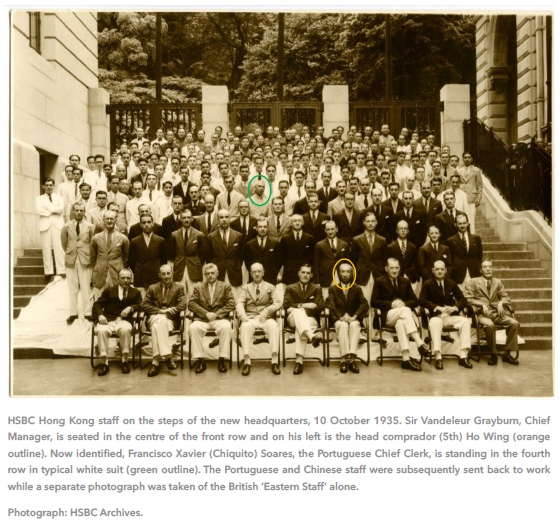
This single act, of separating the staff for the official record, spoke volumes. The Portuguese, whose “accurate, precise, and always presented in excellent calligraphy” work was the engine room of the Bank, were rendered invisible in the formal narrative. [1, p. 529] The Portuguese Chief Clerk, a “personage” in his own right, held no signing authority until the 1960s. [1, p. 529] The community they built within the Bank was vibrant, with its own sporting teams and an annual staff dinner, but it was a community apart. [1, p. 530]

The loyalty of the Portuguese was tested during the serious General Strike of 1925–1926, when the British colonial administration knew it could rely on them totally. Yet this unwavering service made little to no difference to their social standing or to the fact that they were routinely treated with contempt. [7]
War and Aftermath (1941–1960): Loyalty Tested, Promises Broken
The loyalty of the Portuguese community to the Crown and its institutions was put to the ultimate test during the Second World War. Around 300 Portuguese served in the Hong Kong Volunteer Defence Corps (HKVDC). Twenty-six were killed in the fierce but futile defence of the colony. [1, p. 546] (and at least 33 died per following article by Ruy Barretto.)
Some Portuguese bank clerks were also involved in clandestine wartime operations. During the early months of the Japanese occupation a group of sixty British and American bankers, the majority from HSBC, were retained in their positions by the Japanese to liquidate their banks’ holdings and to sign banknotes for issue. Under the cover of their enforced work the bankers concealed a stash of HK$2 million, which they eventually smuggled out to the POW and internment camps. They also kept secret records of all wartime transactions which assisted the retaking of the banks at the end of the war. [13] The wartime role of F.X. Soares himself is illuminated by a remarkable document held in the HSBC Archives. Having escaped to Macao, Soares became the key conduit between the scattered Portuguese staff and the Chief Manager, Sir Arthur Morse, in London. His letter of 6 December 1943, reproduced below, reveals the extraordinary lengths to which he went on behalf of his colleagues.

In this letter, Soares reports that 71 Portuguese staff members and their dependents were receiving relief in Macao, and that he had personally sent Christmas remittances of Yen 20 to each of the 78 interned foreign staff, “including the ladies.” He names the Portuguese relief committee members: C.E. Xavier, C.A. Leon, C.O. Baptista, and C.F.X. Alves, noting that the late A.F. Remedios had been its President. Two of his staff, H. Hyndman and F.C. Collaco, had been arrested by the Japanese “on the charge of distributing relief to the members of staff in Hongkong.” The then Chinese head compradore, Ho Wing, had also been arrested. [14]
The letter also reveals a poignant personal detail: Soares, despite being the most senior Portuguese employee, was himself excluded from British Government Relief because he was a Portuguese citizen. Yet his commitment to the Bank was unwavering. He wrote to Morse with quiet authority:
“I will accept full responsibility of the staff, only if full charge is given to me, as in the past. I leave you to decide on this matter and will let the matter remain as at present until I hear from you.” [14]
Soares’ wartime leadership was recognised by the Hong Kong Manager, John (Jock) Morrison, who wrote in 1942:
“I would like to place on record now that the local staff, both Portuguese and Chinese, behaved in a most exemplary manner during hostilities and that the heads of both sections, Francisco Soares and Ho Wing, gave them all a fine lead.” [14]
The aftermath of the war, however, brought what Stuart Braga terms an “appalling injustice.” In September 1945, the returning British Military Administration extended generous benefits to the European members of the Volunteers, including back-pay to the date of their release. In a stunning act of discrimination, this was denied to the Portuguese, Chinese, and Eurasian members, whose service was deemed to have ended on the day of the surrender in 1941. [1, p. 546] Caroline Braga, daughter of the Portuguese community leader and leading light, J.P. Braga, later lamented:
“Had Father lived, he would have been sadly disappointed with conditions today. All the promises nmade to the Portuguese volunteers before the war were not fulfilled by the British Government.” [1, p. 546]
Despite this stunning injustice, the Portuguese staff were crucial to the Bank’s post-war revival. Records from the HSBC Archives indicate that 188 Chinese and 101 Portuguese employees returned to work in Hong Kong. Some of these men had also been imprisoned and tortured during the war. Several men succumbed to their injuries and never came back. [8]
The new Chief Manager, Sir Arthur Morse, who oversaw the colony’s economic miracle recovery at HSBC, recognised this contribution in a tangible way. In 1949, he authorised the construction of the “Luso Apartments” in northern Kowloon, sixty apartments in three blocks specifically for the families of his clerical staff, who paid a subsidised rent of just 10% of their monthly salary. [1, p. 532] The allocation was managed by a committee of the Portuguese Staff Association. [1, p. 533]

This paternalism extended to the highest levels. In 1951, the President of Portugal conferred upon Sir Arthur Morse the Ordem de Benfeitoria or Order of Benefaction (the Order of Benemerencia was created in 1927 and changed to Order of Benefaction in 1929), an unusual honour explicitly “in recognition of what he did for the Portuguese of Macao.” [9] A decade later, his successor, Michael Turner, received the Commandership of the Order of Prince Henry the Navigator after the Portuguese community expressed their gratitude for his welfare reforms. [10]
The Turning Tide (1960s–1980s): Reform and Exodus
The 1960s were a period of profound change. The three-tier staff system, a relic of a bygone era, was finally dismantled. John Allen, a British officer who was Head of the Securities Department from 1963, provided a vivid snapshot of the Bank on the cusp of this transformation.
“There were between 40 and 50 in the Securities Dept, all but two of whom were Portuguese. This department was part of the Chief Accounts Dept, where there were hundreds of Portuguese. The Portuguese were in charge of the various sections of this department. Indeed all the clerical and supervisory staff were Portuguese. I relied heavily on Mr Hyndman, who was Chief Supervisor of Inward Bills.” [1, p. 532]
This reliance on Portuguese supervisors like Mr. Hyndman was typical, yet the path to executive rank remained closed. However, the winds of change were blowing. The social and political upheaval of the 1967 riots, which convulsed the colony, proved to be a major catalyst. For many in the Portuguese community, the riots were the final straw, accelerating an exodus to Australia, Canada, and the United States. [1, p. 533] The membership of Club Lusitano tells its own story, falling from 450 in 1950 to 176 by 2004. [1, p. 545]. (In the last decade the membership has revitalised and as of 2026 it stands at over 400 and is continuing to grow, with now over 40 young members aged 18 to 32 years of age.)
As the Portuguese old guard began to depart, the Bank was forced to modernise its staffing policies, finally opening the door for local talent, both Portuguese and Chinese, to ascend to managerial positions. A key figure in this new era was A.M. Prado, a Macau-born, Hong Kong-educated Portuguese who became the first Manager of the Macau branch when it finally opened in 1972 after fifteen years of negotiations. He would later become the Bank’s first representative in São Paulo, Brazil, a pioneer of a new, global generation. [11]

The Modern Era: From Clerks to CEOs
The seeds of reform sown in the 1960s and 70s have, in the 21st century, borne spectacular fruit. The journey from the segregated clerical desks of the 19th century to the global boardrooms of the 21st is personified by the recent careers of several highprofile Portuguese bankers at HSBC.
António Simões, who served as CEO of Global Private Banking and prior to that was CEO of HSBC
Bank plc and CEO of Europe.
Diana Cesar, who has risen to become the bank’s Vice Chairman, Hong Kong, as well as Co-CEO of
Asia and Middle East.
Nuno Matos, who served as CEO of Wealth and Personal Banking, one of HSBC’s most senior global
executives.

Diana Cesar, Vice Chairman, Hong Kong, and Co-CEO of Asia and Middle East, HSBC.
Member of Club Lusitano.
Photograph: Tatler Asia.

Nuno Matos, former CEO of Wealth and Personal Banking, HSBC.
Member of Club Lusitano.
Photograph: Caproasia.
Both Diana Cesar and Nuno Matos are members of Club Lusitano.
Their success represents the final and definitive shattering of the colonial glass ceiling. It is the culmination of a 150-year journey, a testament not only to their individual talents but also to the collective legacy of thousands of unnamed Portuguese clerks, supervisors, and managers who served the Bank with skill and loyalty through war and peace, booms and busts.
Conclusion: An Enduring Legacy
The story of the Portuguese at HSBC is the story of Hong Kong in microcosm. It is a tale of resilience,
adaptation, and the quiet pursuit of excellence in the face of ongoing systemic constraints. For a century, they were the indispensable, yet often invisible, gears in the great machine of “Wayfoong,” the “Focus of Wealth.” Theirs was a world defined by the painful reality articulated by Jim Silva: “economically better off than the Chinese… [but on an] economic level much lower than that of the European colonials.” [1, p. 531]
Today, as we sometimes see Portuguese names leading the Bank at a global level, we honour the culmination of that long journey. It is a legacy built on the foundations laid by people like Constancio Gonsalves, E.J. Pereira, Jorge Augusto ("Beany") Remedios, Leo Silva and F.X. Soares, who though denied the ultimate recognition in their own time, endowed their community with a reputation for integrity, diligence, and an unwavering commitment to the institution they helped build.
Acknowledgements
I wish to extend my sincere gratitude to Dr. Stuart Braga, OAM, and Clifford Pereira, MA(Res), FRGS, for their invaluable contributions to this article. Their generous peer review, insightful suggestions, and scholarly corrections have immeasurably improved the accuracy and depth of this work. Dr. Braga’s foundational research in Making Impressions provided the initial spark and critical framework, and he also generously provided the key photograph of the Portuguese staff dinner. Mr. Pereira, an Honorary Research Associate at the University of Hong Kong, a Fellow of the Royal Geographical Society, and a member of Club Lusitano, brought his deep expertise on the Luso-Asian diaspora to add crucial context and nuance. I am also grateful to the HSBC Archives, and in particular to Angharad McCarrick, for kindly providing the high-resolution 1935 staff photograph, which proved instrumental in confirming the identification of F.X. Soares, and for the photograph of Willie Purves and A.M. (Tony) Prado. Any remaining errors are, of course, my own.
Postscript: Solving a Decades-Old Mystery
A small but significant mystery has long surrounded the iconic 1935 HSBC staff photograph: the precise identification of F.X. (Chiquito) Soares, the Portuguese Chief Clerk. While his presence was known, his face remained anonymous in the official record. This article’s research has now solved that
mystery. The breakthrough came from a confirmed family photograph of Mr Soares from his 25th wedding anniversary (c. 1942–1945), publicly available on the genealogy website WikiTree. This provided a clear reference image.

By conducting a careful visual comparison between the family photo and a higher resolution version of the 1935 staff photo (provided by the HSBC Archives), a strong candidate was isolated based on several key features: distinctive silver hair, a lean, angular facial structure, and his positioning in the third row, at the boundary between the British expatriate management and the locally-appointed staff, exactly where the Chief Clerk would be.
To add computational rigour, a facial recognition comparison was performed using the DeepFace library. The state-of-the-art ArcFace model returned a cosine distance of 0.0404 (where 0.0 indicates a perfect match), considered a very strong positive match.
This identification has now been further corroborated by analysis of the c. 1940 Portuguese staff dinner photograph. Facial recognition of the candidate seated to the right of the senior British officer returned an even stronger match for Soares, with a cosine distance of just 0.0198, a near-perfect confirmation. The cross-match between the dinner and 1935 candidates (cosine distances of 0.0341–0.0673) further confirms that all three images show the same person.
The British officer at the centre of the dinner has also now been identified as the Hong Kong Manager, E.J. Davies. This identification is based on a separate, named photograph of the overseas staff from 1935 held by the HSBC Archives, which shows Davies with the same lean build and round glasses. As Hong Kong Manager, Davies had direct oversight of the locally-appointed Portuguese and Chinese staff, making his presence at their annual dinner entirely logical. The seating arrangement, with his Chief Clerk, F.X. Soares, naturally placed at his right hand, follows the expected protocol of the day.
References
[1] Braga, Stuart. Making Impressions: A Portuguese Family in Macau and Hong Kong, 1700–1945. Macau: International Institute of Macau, 2013. Chapter 14: ‘A community apart: the Portuguese in twentieth-century Hong Kong.’
[2] King, Frank H.H. The History of The Hongkong and Shanghai Banking Corporation, Vol. I: The Hongkong Bank in Late Imperial China, 1864–1902. Cambridge: Cambridge University Press, 1987, p. 223.
[3] King, Frank H.H. The History of The Hongkong and Shanghai Banking Corporation, Vol. III: The Hongkong Bank between the Wars and the Bank Interned, 1919–1945. Cambridge: Cambridge University Press, 1988, p. 266.
[4] King, Frank H.H. The History of The Hongkong and Shanghai Banking Corporation, Vol. I. Cambridge: Cambridge University Press, 1987, pp. 251 252.
[5] King, Frank H.H. The History of The Hongkong and Shanghai Banking Corporation, Vol. I. Cambridge: Cambridge University Press, 1987, p. 136.
[6] King, Frank H.H. The History of The Hongkong and Shanghai Banking Corporation, Vol. II: The Hongkong Bank in the Period of Imperialism and War, 1895–1918. Cambridge: Cambridge University Press, 1988, p. 592.
[7] Braga, Stuart. Making Impressions. Macau: International Institute of Macau, 2013, p. 548.
[8] “Our Darkest Hours: The Bank Returns,” HSBC History. https://history.hsbc.com/exhibitions/ourdarkesthours- the-bank-returns
[9] King, Frank H.H. The History of The Hongkong and Shanghai Banking Corporation, Vol. IV: The Hongkong Bank in the Period of Development and Nationalism, 1941–1984. Cambridge: Cambridge University Press, 1991, p. 247.
[10] King, Frank H.H. The History of The Hongkong and Shanghai Banking Corporation, Vol. IV. Cambridge: Cambridge University Press, 1991, p. 251.
[11] King, Frank H.H. The History of The Hongkong and Shanghai Banking Corporation, Vol. IV. Cambridge: Cambridge University Press, 1991, p. 608.[12] Pereira, Clifford. ‘Goans of the North Atlantic: A Transnational Study of Migration, Technology Adoption, and Neoculturation Across Six Generations.’ In Migration, Technology and Transculturation: A Global Perspective. Lindenwood University Press, 2011, Chapter 8.
[13] Yap, Felicia. ‘Portuguese Communities in East and Southeast Asia During the Japanese Occupation.’ In The Making of the Luso-Asian World: Intricacies of Engagement. Institute of Southeast Asian Studies, 2011, Chapter 9.
[14] “The Local Touch,” HSBC History. https://history.hsbc.com/exhibitions/the-local-touch. Includes the Soares letter to Morse (6 December 1943) and Morrison’s commendation (1942).
[15] “About HSBC Hong Kong,” HSBC. https://www.about.hsbc.com.hk/ : “The third generation head office, completed in 1935, was the first air-conditioned building in Hong Kong.”
Image Credits
1. HSBC Headquarters, c. 1935. HSBC Archives.
2. HSBC Hong Kong Staff, 10 October 1935. HSBC Archives.
3. Annual dinner of the Portuguese staff, c. 1940. Jack Braga Collection, courtesy of Dr. Stuart Braga, OAM.
4. Letter from Francisco Soares to Sir Arthur Morse, 6 December 1943. HSBC Archives, courtesy of HSBC History (history.hsbc.com).
5. The Luso Apartments, Kowloon Tong. Photograph: 28Hse.com.
6. Willie Purves and A.M. (Tony) Prado, 1980. HSBC Archives.
7. Diana Cesar. Photograph: Tatler Asia. Used for editorial purposes; permission requested for publication [request sent 2026/3/11].
8. Nuno Matos. Photograph: Caproasia. Used for editorial purposes; permission requested for publication [request sent 2026/3/11].
9. The Soares family, c. 1942–1945. WikiTree / Soares family